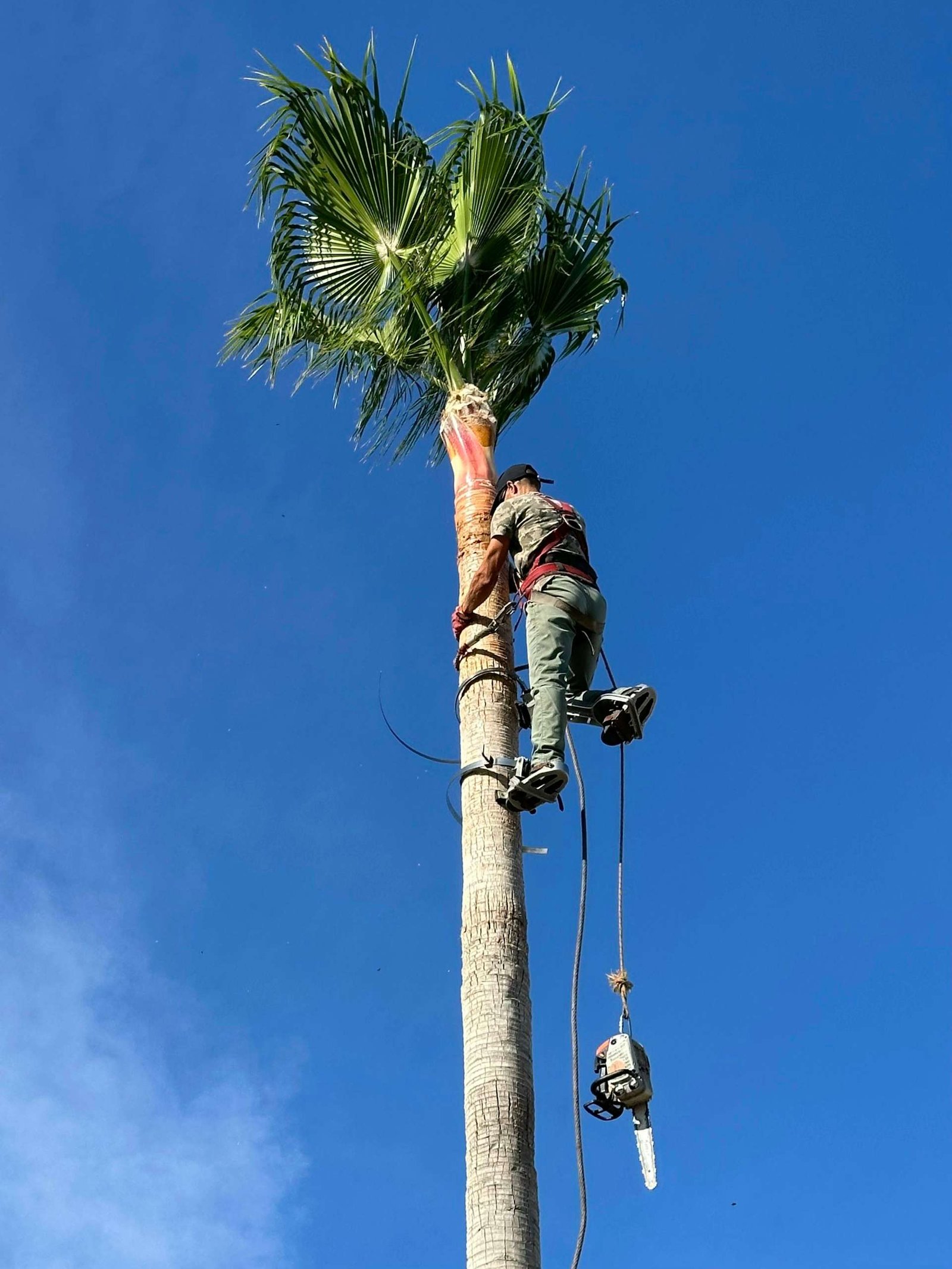
Palm tree trimming in Mobile, AL, done the right way
We provide palm tree trimming in Mobile, AL for homeowners who want a clean, full crown instead of a stripped-down pineapple top. Our crews remove dead fronds and seed stalks, keep every green frond, and never climb a palm on spikes.
Palms are not true trees. They have one growing bud at the top of the trunk, no branches to shape, and no way to seal over a wound. UF/IFAS warns that over-pruning is one of the most common mistakes with palms, and it leaves them weaker, not safer. For oaks, pines and crape myrtles, see our main tree trimming service.
Which palms grow around Mobile
The palms you see most around Mobile and the Eastern Shore are sabal (cabbage) palms, Washingtonia fan palms, pindo palms and windmill palms, with Canary Island date palms and Chinese fan palms in warmer spots.
- Sabal palm (cabbage palm). Alabama Extension counts four native palm species, and the cabbage palm is the only one that grows tall. It is Florida’s state tree, reaches about 35 to 40 feet, and ranks among the most wind-resistant trees in UF/IFAS hurricane research.
- Washingtonia (Mexican fan palm). Fast and very tall, often 50 feet or more in older yards. Fronds burn at 12 to 15 degrees, and it survived hurricanes poorly in south Florida studies.
- Canary Island date palm. A heavy, wide crown with sharp spines at the frond bases. Rated for zone 9a, so a hard Mobile freeze can damage it. Very wind-resistant when the crown is left full.
- Pindo (jelly) palm. Short, blue-green and cold-hardy to about 8 degrees, with sticky orange fruit that stains driveways. Seed stalk removal is the main job.
- Windmill palm. The hardiest trunked palm here, rated to 0 to 5 degrees. Slim, slow and easy to trim from a ladder.
- Chinese fan palm and queen palm. Both are marginal in Mobile. Chinese fan palm fronds burn below 25 degrees, and queen palms take damage well above their listed 17-degree limit.
How much to trim: the 9-to-3 rule
Remove only completely dead, brown fronds and the flower or fruit stalks. Never cut a frond whose tip sits above the horizontal line from 9 o’clock to 3 o’clock on the crown.
That line comes from the ANSI A300 pruning standard, and UF/IFAS Extension is clear that it is an absolute limit, not a goal. A healthy palm should look round and full after a trim, not like a feather duster. Our crews follow a few other rules from the same research:
- Leave yellowing lower fronds alone. Half-dead or discolored lower leaves usually mean potassium deficiency, and cutting them speeds up the decline. Fertilizer fixes that; a saw does not.
- Never cut into the trunk. Palms cannot compartmentalize wounds the way an oak can. Trunk cuts and pencil-pointing invite trunk rot for the life of the palm.
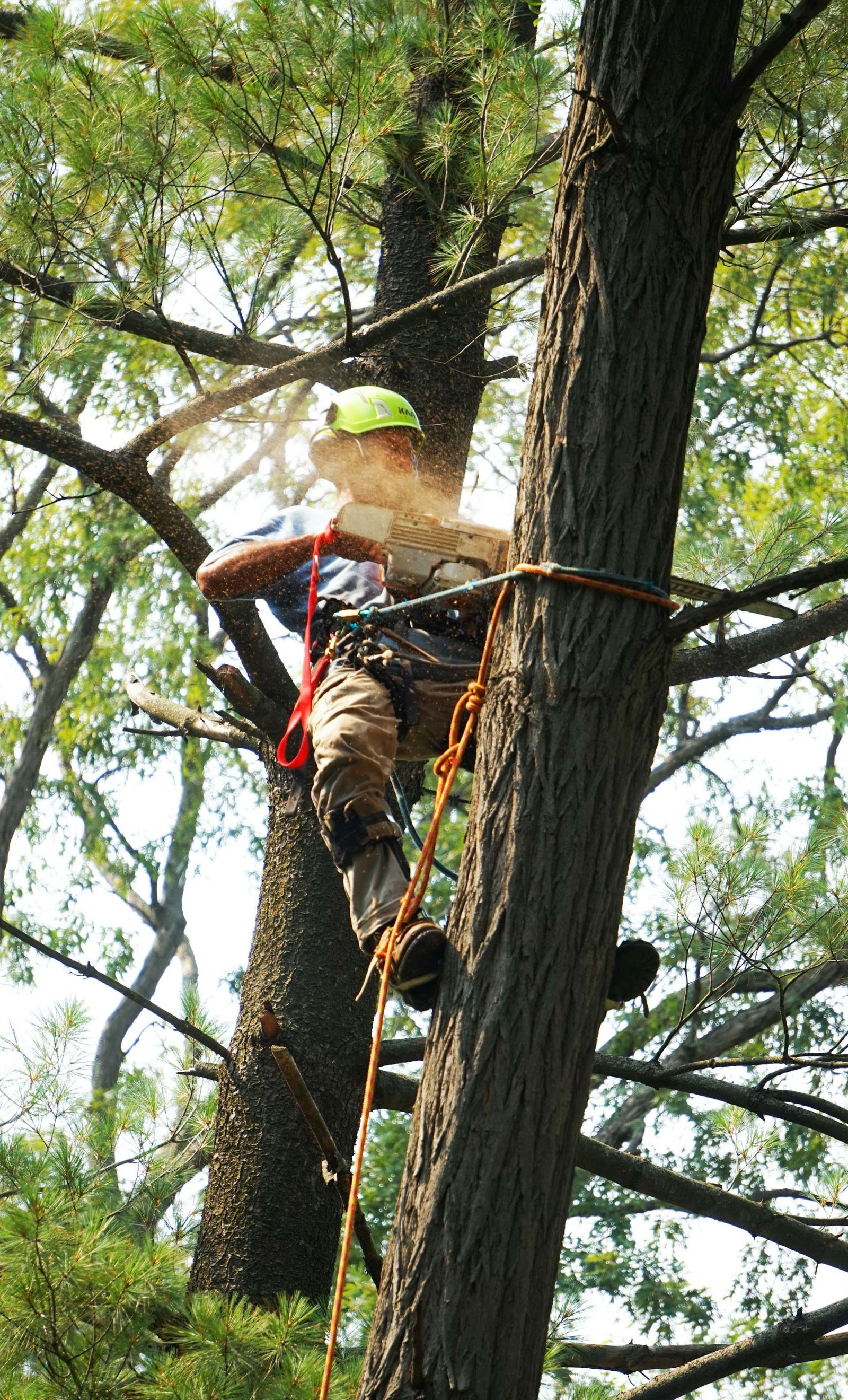
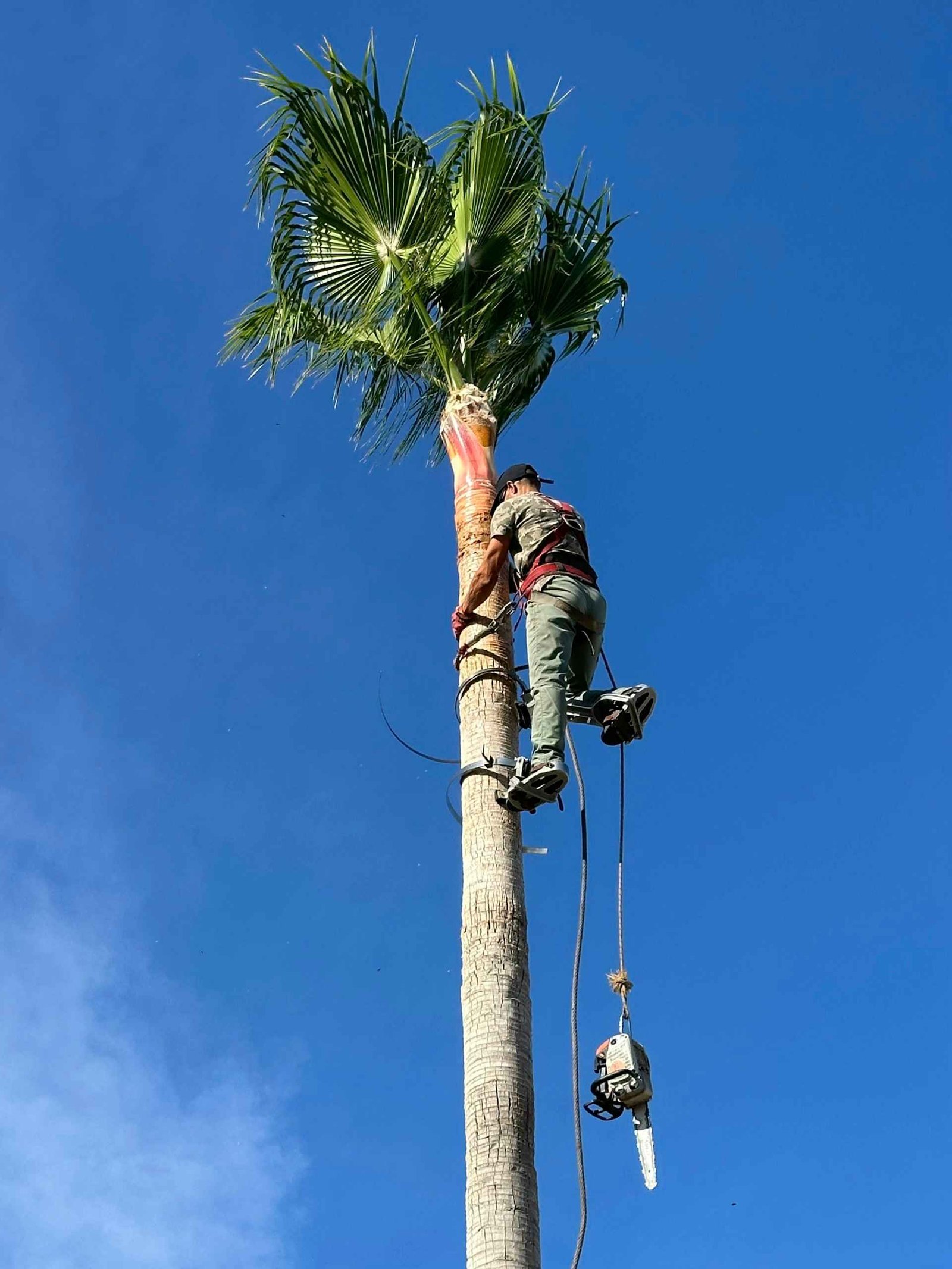
- No climbing spikes. Spike holes in a palm trunk never heal and become entry points for disease. We use a ladder, a rope-and-saddle climb or a lift.
- No forcing the boots. Old frond bases that do not pull away easily are left in place.
Why hurricane cuts hurt palms
A hurricane cut strips a palm down to a few upright fronds, and it makes the palm weaker in a storm, not safer. UF/IFAS found that after the 2004 and 2005 hurricane seasons, over-pruned palms were more likely to have their crowns snapped off than palms with fuller crowns.
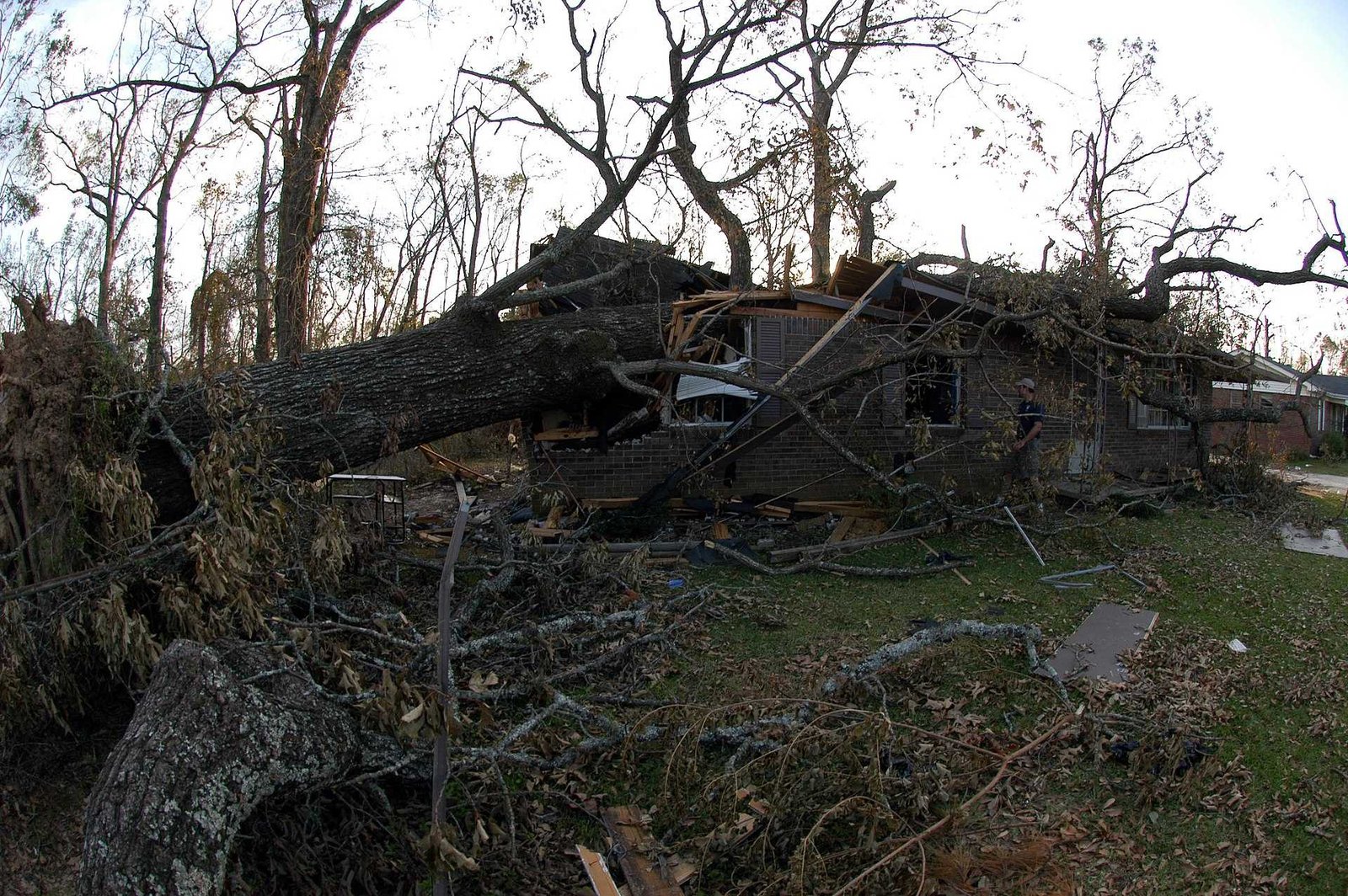
Green fronds are the palm’s food supply, and the layered frond bases around the bud act like a shock absorber in high wind. Take most of them away and the trunk narrows, new fronds come in smaller, and the bud is left exposed. UF/IFAS research also shows that a lightly pruned palm can lose every frond in a hurricane and keep growing, as long as the bud survives. That is how sabal palms came through Ivan in 2004 and Katrina in 2005 while water oaks and pines around them failed.
Palm trimming before hurricane season
The best time for a palm clean-up in coastal Alabama is late spring, in April or May, before hurricane season opens on June 1. Dead fronds can be removed any time of year.
UF/IFAS says there is no better or worse season from the palm’s point of view, so the storm calendar is what matters. Loose brown fronds and heavy seed stalks become projectiles in hurricane winds, so clearing them before June 1 is worth doing. Clearing green fronds is not. Our hurricane tree prep guide for Mobile covers the rest of the yard, and the Alabama pruning calendar shows where palms fit next to oaks and crape myrtles.
Palm tree trimming cost in Mobile
Palm trimming in the Mobile area typically costs $100 to $650 per palm in 2026, and most palms under 30 feet fall between $100 and $350. Palm removal typically runs $200 to $1,500 or more, depending on height and access. These are typical estimates built from national cost guides and adjusted for the Gulf Coast, not quotes.
| Job | Typical 2026 Mobile-area range | What drives it |
|---|---|---|
| Palm trim, under 30 ft | $100 – $350 | Ladder work or a climb, number of fronds |
| Tall palm trim, 30 ft+ | Up to $650 | Bucket truck, rigging near roofs or lines |
| Seed pod and fruit stalk removal | $50 – $150 per palm | Added to a trim; pindo and date palms |
| Palm removal | $200 – $1,500+ | Height, trunk weight, haul-away, sectioning over structures |
| Palm stump grinding | $100 – $450 per stump | Usually toward the low end for a palm |
Height is the biggest factor, because a 50-foot Washingtonia needs a lift. Several palms in one visit usually lowers the cost per palm. We list clean-up and haul-away on the written estimate. For how palm prices compare with oaks and pines, see the tree trimming cost guide for Mobile.
Palm tree removal and stump grinding
A palm should come out when its bud has died, when it is diseased, when it has outgrown a spot next to the house or pool, or when freeze damage has left it bare for a full season. Removal is priced by height, access and how the trunk has to come down.
Palm trunks look light but are dense, wet and heavy, so a tall palm near a structure is cut in sections and lowered rather than felled. In a tight backyard we may bring in a small crane, as with large oaks in our tree removal service.
Palms have a dense mat of thin fibrous roots instead of large lateral roots, so a grinder clears a palm stump quickly, usually 6 to 12 inches below grade. Stump grinding in Mobile covers that, and grinding is strongly recommended for any palm lost to Ganoderma.
Palm diseases to watch for
Two diseases kill palms on the Gulf Coast, and neither can be cured once a palm shows symptoms: lethal bronzing and Ganoderma butt rot.
Lethal bronzing is caused by a phytoplasma, a bacteria-like organism, that is carried from palm to palm by a small sap-feeding insect called a planthopper. UF/IFAS lists 21 host species, including cabbage, queen, Canary Island date and windmill palms. The first signs are fruit dropping early and the oldest fronds turning bronze. Within two to three months the center spear leaf collapses and the palm dies.
The disease is confirmed across Florida and in Louisiana. Alabama had no confirmed cases as of 2019 news reports, but most ornamental palms sold here come from Florida nurseries, so ask for certified stock. UF/IFAS advises removing a palm with symptoms right away and having nearby healthy palms injected with oxytetracycline, an antibiotic, every three to four months by a licensed applicator or arborist.
Ganoderma butt rot is a fungus that decays the lower 4 to 5 feet of the trunk. The tell-tale sign is a hard, shelf-like conk at the base, though many palms die before one appears. Every palm species is susceptible, there is no treatment, and the fungus lives on in the stump. Grind the stump and do not plant another palm in that spot.
Cold damage is the third thing to check after a hard freeze. A palm with brown fronds but a firm green spear will usually push new growth by summer, so wait at least six months before writing it off.
Get a free palm trimming estimate
Request a free written estimate and our insured crew will trim to the 9-to-3 rule and tell you honestly when a palm needs nothing at all. Our crews work across Mobile, Theodore, Tillmans Corner, Saraland, Daphne, Fairhope and Spanish Fort. If a palm is already leaning over the house after a storm, ask for the storm line instead of waiting for a routine visit.