Key takeaways
Signs a tree is dangerous: the short answer
The clearest signs a tree is dangerous are large dead branches, deep cracks, rot or cavities, mushrooms at the base, and a new lean with cracked or lifted soil. The risk is highest when a tree with these defects could hit your house, car, a driveway, a street or people. If you see any of these, have an arborist look at the tree before the next big storm.
In Mobile, that question comes up every hurricane season, which runs June 1 to November 30. It also comes up after the summer thunderstorms that drop inches of rain in an afternoon. Here is what to look for and what to do about it.
First, what makes a tree a hazard?
A tree becomes a hazard when it has a defect and something valuable is within reach if it fails. The Alabama Cooperative Extension System puts it plainly: without a potential target, a tree cannot qualify as a hazard.
A cracked pine in the back of a 10-acre lot in Semmes is a much lower concern than the same pine leaning over a bedroom in Midtown. As you walk your yard, ask two questions of every big tree. Does it show warning signs? And what would it hit?
12 warning signs of a dangerous tree
These signs come from the International Society of Arboriculture’s tree risk checklist and Alabama Extension’s hazard tree guidance, plus what we see most often on the Gulf Coast.
1. Dead branches and hangers
Dead branches in the canopy are probably the most obvious hazard, according to ISA. The risk depends on the size of the limb and how close it is to targets. Hangers, which are broken limbs caught in the canopy, are especially dangerous because they can drop without warning, sometimes weeks after a storm.
2. Cracks and splits
Look for cracks running up and down the trunk, across it, or through a branch union. Alabama Extension notes that cross-wise cracks weaken the wood’s structure and lengthwise cracks let fungi and decay in. A crack that opens and closes in the wind is a serious sign.
3. Co-dominant stems with included bark
Co-dominant stems are two trunks of similar size growing from the same point. They can often be failure points. The risk is higher when the union is a tight V-shape with bark pinched between the stems, called included bark. U-shaped unions are generally stronger. Fast-growing water oaks and laurel oaks often develop this kind of union.
4. Cavities and decay
Open cavities, soft or crumbly wood, and sap or dark fluid leaking through the bark can all point to internal decay. Alabama Extension also lists carpenter ants and cavity-nesting wildlife as clues. A hollow trunk is not always weak, but it needs a professional to measure how much sound wood is left.
5. Mushrooms or conks at the base
Mushrooms at the base of a tree, or shelf-like conks on the trunk or roots, are the fruiting bodies of fungi. ISA lists them as a sign of decay. When they appear on the root flare, they can mean root rot, which can let a healthy-looking tree topple in a storm.
6. A lean with heaving or cracked soil
Many trees lean safely for years. ISA warns that cracks or separations in the soil can mean the roots are moving, especially if the tree is leaning. A lean that is new or getting worse, with mounded soil on the side away from the lean, is one of the most urgent signs on this list. Saturated soil after heavy rain makes it worse.
7. Root damage from construction
Trenching for utilities, new driveways, grade changes, soil compaction and fill dirt can kill roots that hold the tree up. ISA lists construction, grade changes and compaction as common human-caused defects. Symptoms often show up several years after the work is done, as thinning leaves and dieback.
8. Dead or thinning crown
A crown with sparse leaves, leaves that are unusually small or yellow, or dead branch tips at the top can signal root problems or disease. On pines, needles that fade from green to yellow to red or brown often mean bark beetles, according to Alabama Extension. A beetle-killed pine becomes brittle and should come down soon. See our pine tree removal guide for details.
9. Loose or falling bark
ISA’s checklist asks whether there is loose bark on the trunk. Bark falling off in patches, with bare wood showing underneath, often means that part of the tree is dead. On pines, look closely for pitch tubes and reddish boring dust nearby.
10. Trees near power lines
Any tree that could fall into a service line or a street line is a serious situation. ISA warns never to remove branches from or near power lines, and never go near downed lines, because they may still be live. Call your electric utility for anything touching a line.
11. Recent storm damage
After a hurricane or strong thunderstorm, look for split limbs, twisted tops, torn bark and new leans. Research on Gulf Coast hurricanes, including Ivan in 2004, found that saturated soils lead to more uprooting. Trees that survived one storm with root damage may fail in the next.
12. Past topping or heavy pruning
ISA’s checklist also asks whether the tree has been topped or heavily pruned. Topping leaves stubs that decay and produces fast, weakly attached sprouts. Those sprouts often break in storms. Proper tree trimming that follows ANSI A300 standards avoids this problem.
Tree risk table: what to do about each sign
Use this table as a quick guide. It is not a substitute for an on-site inspection.
| Warning sign | Typical risk level | What to do |
|---|---|---|
| Hanger or broken limb over a roof, driveway or path | High | Keep people clear and call a pro right away |
| New or worsening lean with heaving or cracked soil | High to urgent | Stay out of the fall zone and call for an emergency inspection |
| Tree or limb touching a power line | Urgent | Stay back and call your electric utility first |
| Deep crack through the trunk or a major union | High | Schedule an arborist inspection soon |
| Mushrooms or conks at the root flare | Moderate to high | Have decay assessed, especially near targets |
| Cavity or soft, rotten wood in the trunk | Moderate to high | Have remaining sound wood evaluated |
| V-shaped co-dominant stems with included bark | Moderate | Consider pruning, cabling or removal based on inspection |
| Large dead branches | Moderate to high | Prune them out before storm season |
| Thinning or dying crown | Moderate | Diagnose the cause, whether roots, disease or beetles |
| Loose or falling bark | Moderate | Check for dead sections and beetle activity |
| Root damage from recent construction | Moderate, rising over time | Monitor for dieback and have roots checked |
| Past topping | Moderate | Corrective pruning over several seasons |
Risk levels here are general guidance. The actual risk depends on the tree’s size, the defect’s severity and what the tree could hit.
How arborists assess tree risk
Arborists use a standard, step-by-step process to rate tree risk. Alabama Extension describes three levels of assessment:
- Level 1, limited visual: a quick walk-by check for obvious defects, often from one side.
- Level 2, basic: a full walk-around inspection of the roots, trunk, branches, crown and site from several angles, using simple tools such as a mallet, probe and binoculars.
- Level 3, advanced: more detailed testing with specialized equipment such as sonic tomography or resistance drills, used when a key defect needs measuring.
Many professionals are trained in this process through the ISA Tree Risk Assessment Qualification, known as TRAQ. According to ISA, it requires a two-day course followed by a written test and a field assessment. Holders must retrain and retest every seven years. The arborist then recommends ways to lower the risk, such as pruning, cabling and bracing, routine care or removal.
What homeowners can check safely
You can spot many warning signs yourself without any risk. Do it a few times a year and after every major storm.
- Walk all the way around each large tree near the house, driveway or street.
- Look up with binoculars for hangers, dead limbs and cracks in the upper crown.
- Check the base for mushrooms, cavities, cracked soil and fresh boring dust.
- Compare photos from season to season to see whether a lean is changing.
- Stay on the ground. Do not climb, do not cut large limbs and do not stand under hangers.
- Stay away from power lines, even if they look dead.
If a tree does not look right to you, trust that instinct and ask for a professional opinion. Our hurricane tree prep guide has a pre-season checklist for Mobile homeowners.
When a dangerous tree is an emergency
Some situations cannot wait for a scheduled visit. Treat these as emergencies:
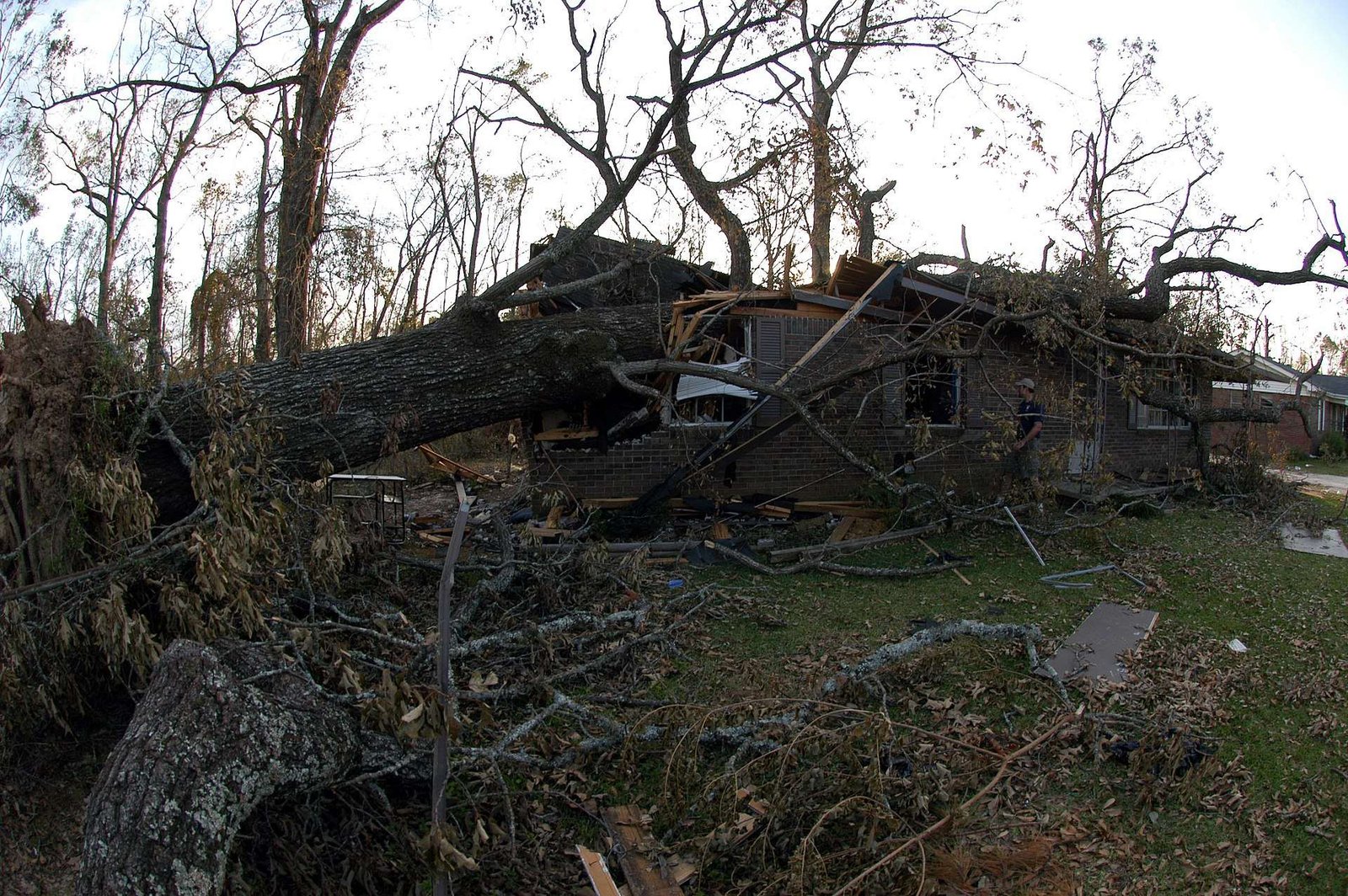
- A tree or large limb has fallen on your house, car or garage.
- A tree is leaning more than it was yesterday, with cracking or lifting soil.
- A tree is touching or tangled in a power line. Call the utility first.
- A split trunk or hanging limb is over a doorway, driveway or street.
Keep everyone out of the fall zone, which is at least as far as the tree is tall. Then send an urgent request through our emergency tree service page. If a tree has already hit your home, take photos before anything is moved, and read our guide on what to do when a tree falls on your house in Alabama. For trees that need to come down but are not yet an emergency, start with a free written estimate for tree removal.
How we write our guides