Key takeaways
Pine tree removal in Mobile: the short answer
Most pine tree removal jobs in the Mobile area cost about $450 to $1,800 in 2026. The price depends mostly on height, how close the pine is to your house or power lines, and whether you want the stump ground. Homeowners usually call us for one of three reasons: the pine is dying from bark beetles or a lightning strike, it started leaning after a storm, or it simply grew too tall and too close to the roof.
Pines are everywhere in Mobile County, from the big lots in Semmes and Wilmer to older neighborhoods off Airport Boulevard. They grow fast, they get tall, and when one fails it can reach a long way. This guide covers what to look for, what the work costs and what to plant afterward.
The pines we see most in Mobile County
Three southern pines make up most of the tall evergreens in local yards. Knowing which one you have helps explain how it behaves in storms and how it may be attacked by insects.
- Loblolly pine grows fast and tall, and it has largely replaced longleaf in Alabama’s planted forests because it produces timber quickly. Many 70- to 100-foot pines towering over Mobile homes are loblolly.
- Longleaf pine is Alabama’s state tree. The University of Alabama Arboretum notes its needles are 10 to 18 inches long, in bundles of three, crowded at the branch tips. It grows more slowly but is valued for its durability and resistance to disease and fire.
- Slash pine is another fast grower that does well along the Gulf Coast. It has long needles and glossy cones and shows up often in Baldwin County and south Mobile County yards.
All three have long, straight trunks with most of the weight up high. That shape is part of why a failed pine can do so much damage.
Why pines get removed on the Gulf Coast
Pines are tough, but a few problems show up again and again here. Most removals we are asked about trace back to insects, lightning, storms or simple location.
Southern pine beetle and Ips engraver beetles
The Alabama Cooperative Extension System lists three bark beetles that attack Alabama pines: the southern pine beetle, Ips engraver beetles and the black turpentine beetle. Extension experts say most of them go after pines already stressed by drought, flooding, overcrowding or storm damage. During outbreaks, the southern pine beetle can attack even healthy trees.
Ips beetles tend to show up after hurricanes and dry summers, when many pines are stressed at once. Construction stress also matters. Trenching, soil compaction and fill dirt piled over roots all weaken a pine’s natural defenses.
Lightning strikes
Tall pines are often the highest point in a yard, so they take a lot of summer lightning. A strike can split the trunk, blow off strips of bark or kill the tree outright. Even a strike that looks minor stresses the pine, and stressed pines are exactly what bark beetles look for. A struck pine that looks alive in July can be brown a few months later.
Leaning after storms and wet soil
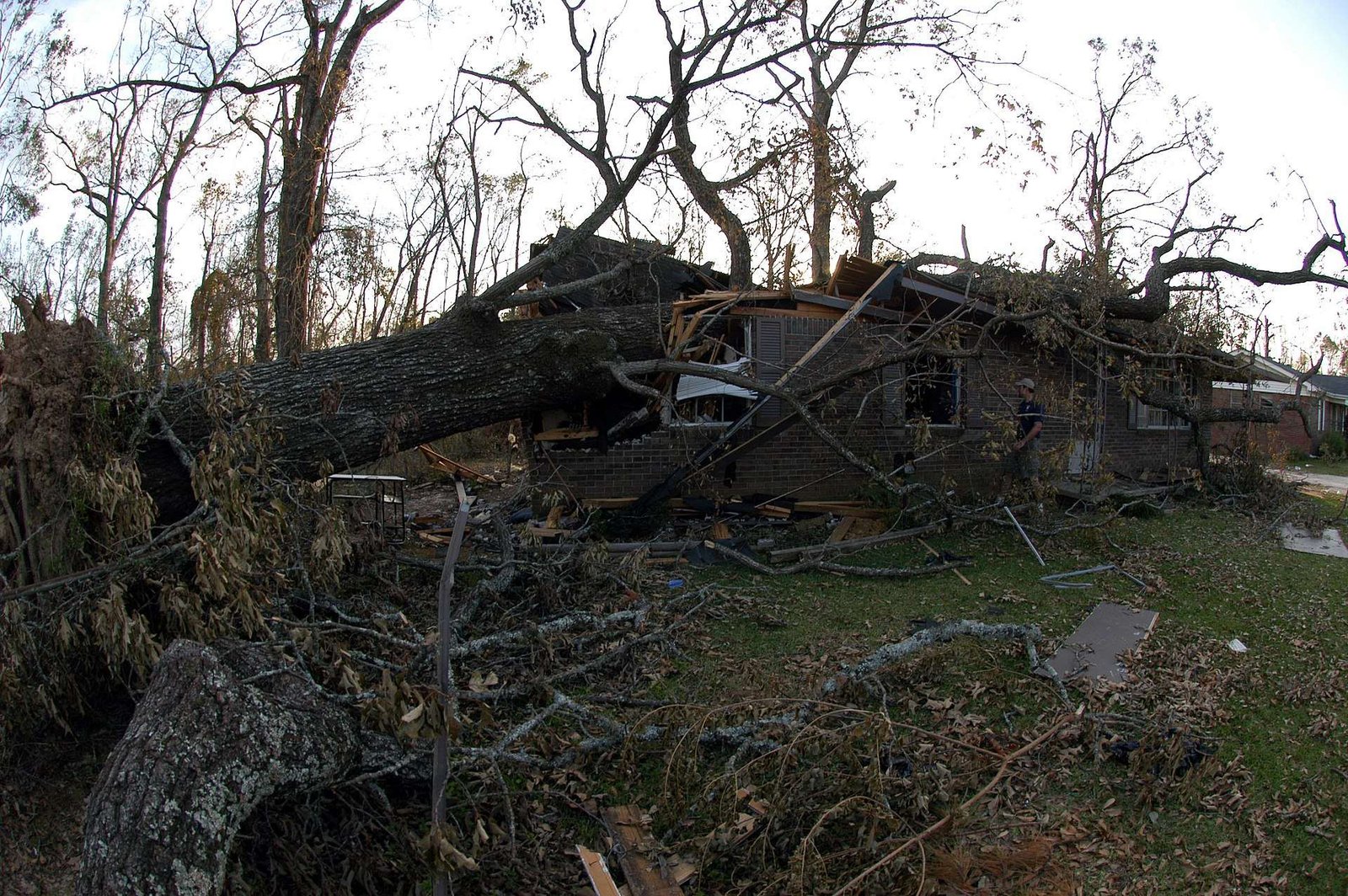
Hurricanes such as Ivan in 2004 and Sally in 2020 left many Mobile-area pines leaning or uprooted. Research on Gulf Coast hurricanes found that heavy rain and saturated soil lead to more uprooting. When the ground turns to mush, the root plate can lift and rotate even if the trunk never breaks.
In University of Florida research after Hurricane Ivan, pines survived at lower rates than live oaks. Slash pine came in around 71 percent, loblolly 64 percent and longleaf 57 percent, while live oak survival was 91 percent.
Simply in the wrong spot
Many pines were planted, or left standing, when a house was built 30 or 40 years ago. Now they are 80 feet tall and 15 feet from the bedroom. Even a healthy pine can be a reasonable removal when it is sized for a forest, not a small yard.
Signs a pine tree is dying
A dying pine usually shows it first in the needles and bark. Walk around the tree and look up with binoculars if you have them.
- Fading needles. Extension experts describe needles turning from green to yellow, then red or brown. Once the whole crown fades, the tree is usually past saving.
- Pitch tubes. Small blobs of sap on the bark that look like popcorn or a wad of gum. Southern pine beetle tubes are often white to yellow. Black turpentine beetle tubes near the base can be over an inch across.
- Reddish boring dust. Fine reddish sawdust caught in bark crevices or piled at the base.
- Small round exit holes. Birdshot-sized holes in the bark mean a new generation of beetles has already flown.
- Bark that peels away easily. Winding S-shaped tunnels under the bark point to southern pine beetle. Y- or H-shaped tunnels point to Ips.
- Cracked or raised soil at the base. On a leaning pine, this suggests root failure.
One note from Mississippi State University Extension: white sawdust at the base often comes from ambrosia beetles. These are secondary insects that move into trees already dying from other causes. The tree is still in trouble, but the beetles are a symptom, not the cause.
For a broader checklist that covers oaks and other trees, see our guide to the signs a tree is dangerous.
How much does pine tree removal cost in Mobile?
Pine tree removal cost is driven mainly by height, then by access and hazards. National data from LawnLove puts pine removal at about $475 to $1,450, and removal of trees over 80 feet at $1,160 to $2,000. We adjust those figures for the tall pines, sandy lots and tight older neighborhoods we see around Mobile.
| Pine height | Typical 2026 estimate (Mobile area) | What usually drives the price |
|---|---|---|
| Under 30 feet | $250 – $600 | Open yard, simple felling, small cleanup |
| 30 – 60 feet | $450 – $1,200 | Sectioning from a climber or bucket, more debris |
| 60 – 80 feet | $900 – $1,800 | Rigging over roofs, fences or pools |
| Over 80 feet | $1,200 – $2,500+ | Crane or heavy rigging, road or line hazards |
| Stump grinding (add-on) | About $100 minimum, often $2 – $5 per inch | Stump diameter, roots, access |
These are typical 2026 estimates for the Mobile area, not quotes. Prices go up when a pine leans over the house, sits near a power line, or needs a crane because there is no safe place to drop sections. Beetle-killed pines can also cost more once they have been dead a while, because dry, brittle wood is less predictable to rig and climb.
For a full breakdown of what affects the price, read our tree removal cost guide for Mobile. If your pine hangs over a roof with no drop zone, crane tree removal is often the safest option.
Sap, resin and stump considerations
Pines bleed sticky resin when they are cut, and it is hard to get off cars, decks and driveways. We tarp or protect surfaces near the work area and ask you to move vehicles before we start. Pine logs are also heavy with sap, so plan on the full haul-away unless you want to keep some wood.
Handle beetle-infested wood carefully
Extension experts in Alabama say cutting, chipping or debarking infested trees helps stop the spread. Do not stack beetle-infested pine as firewood next to your healthy pines. Chipping it or hauling it away is the safer choice.
The stump
Loblolly, longleaf and slash pines do not normally resprout from the stump. The stump will slowly rot, but in our humid climate a rotting stump can draw termites and fungi. Most homeowners have it ground 6 to 12 inches below grade so they can mow and plant. Our stump grinding service can be added to the same estimate. If you are unsure whether you need grinding or full extraction, compare them in our stump grinding vs stump removal guide.
Can a pine tree be saved?
Sometimes, but usually only if you catch the problem early. The answer depends on what is wrong with the tree.
- Bark beetles: Once beetles are established under the bark and the needles are fading, the tree cannot be saved. Mississippi State University Extension says insecticide at that point is too late. Prompt removal can kill larvae before they emerge and spread to nearby pines.
- Prevention for high-value pines: Extension experts note that preventive bark sprays such as bifenthrin or permethrin can protect a valuable, healthy pine during an outbreak. This must be done before an attack and is hard to do well on very tall trees.
- Lightning: A narrow bark scar on an otherwise green pine may heal. Watch it closely for pitch tubes and fading needles over the next few months.
- Leaning: A slow, old lean with firm soil can be stable. A new lean after a storm, with heaving or cracked soil, is not something to wait on.
- Stress: Keep heavy equipment, fill dirt and trenching away from the root zone of pines you want to keep.
Replanting after a pine comes down
The best replacement is a tree matched to the space you have. If the old pine was close to the house, consider something smaller or more wind-firm rather than another 90-foot pine.
- Live oak, southern magnolia and sabal palm had high survival in Gulf Coast hurricane research. Give a live oak plenty of room, because its spread can match or exceed its height.
- Longleaf pine is a good choice for large, open lots. It grows more slowly than loblolly and is valued for its resistance to disease and fire.
- Plant away from the old stump. Grind the stump, remove most of the wood chips and add topsoil before replanting in the same spot.
- Plant in the cooler months. Planting in fall or winter gives roots time to settle in before the summer heat.
When a pine needs attention right away
If a pine is newly leaning, cracked at the base, or hung up in another tree after a storm, keep people and pets away from the fall zone. Stay well clear of any tree touching a power line and call your utility first. For urgent problems, our emergency tree service crews handle storm-damaged and hazardous pines. For everything else, a free written estimate for tree removal is the best next step.
How we write our guides